Article
The Shadow Self: What we resist, controls us
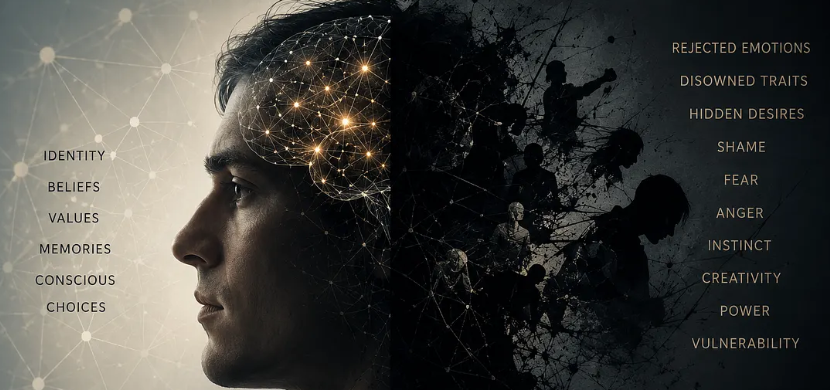
For most people, the idea of the "shadow self" conjures up images of hidden darkness — suppressed anger, shame, jealousy, trauma, or socially unacceptable desires lurking somewhere beneath conscious awareness. The concept originates with Carl Jung, who described the shadow as the parts of ourselves we reject, repress, or refuse to identify with.
But modern neuroscience suggests something more interesting may be happening. What if the shadow is not simply hidden content, but an active process of resistance within the brain itself?
In contemporary predictive processing theories of the brain, consciousness is increasingly understood not as passive perception, but as an active simulation engine. The brain continuously predicts reality, predicts identity, predicts emotion, and suppresses information that conflicts with its preferred internal models.
Under this framework, the shadow may not merely be "bad parts of ourselves." It may instead represent emotionally charged predictive patterns that the brain is actively working to inhibit in order to maintain a stable identity.
In other words, the shadow is not just the unconscious. The shadow is what we have resisted experiencing.
This reframing aligns surprisingly well with my own personal self-development research. For some years I was involved in the Avatar Course, which encourages us to reflect on our own behavior and beliefs through patterns of desire and resistance. From that perspective, psychological fixation occurs when the mind is both drawn toward and repelled from the same thing at the same time, creating uncomfortable and often ambiguous sensations of conflict. A person may desire intimacy while resisting vulnerability. Desire success while resisting exposure. Desire peace while resisting uncertainty, and so on. The resulting unresolved and unidentified tension becomes not only self-reinforcing, but often self-sabotaging.
Neuroscience increasingly supports the idea that suppression is not energetically free. This means the brain must continuously expend energy monitoring, predicting, and inhibiting unwanted emotional or behavioral tendencies. These tendencies can be thought of as programming that resulted from past emotionally charged experiences, where we resisted feeling some or all of the emotion involved in the experience. The more emotionally charged the original event was, the more energetically consuming it may remain beneath conscious awareness.
Within my own consciousness research, I've become increasingly interested in whether many emotional struggles are maintained not by the existence of emotions themselves or the somatic experience (bodily encoded memory) of those emotions, but by our ongoing resistance to experiencing emotion itself. This may sound complex but think of it this way: a lot of the time we get immediate relief once we re-experience the feeling of resistance. Once we have done that, we realize that feeling the underlying emotion was not so bad after all. It was the resistance to feeling the emotion that was causing it to stay locked in place.
If we can learn and practice the skills of dissolving or 'deprogramming' sensations of resistance, it can be immensely freeing, because we are literally liberating stuck energy in the brain. Shadow material often emerges under stress, alcohol, meditation, psychedelics, exhaustion, or emotional overload. The inhibitory systems maintaining identity coherence (who you think you are) temporarily weaken, allowing previously resisted emotional structures to surface and be re-experienced. This is why self-development seminars can be very effective with dissolving resistance and reprogramming ourselves, as they provide both the tools to learn how to dissolve resistance, and a safe environment to pressure-test our emotional systems to reveal shadow programming.
Traditional repression attempts to push emotional material away, with the effect that it strengthens the very patterns it seeks to suppress. Once we have started to welcome resistance as a sign we are onto something, we can use contemplative and attentional practices that include careful observation of the structure of the emotion without focusing on the content or meaning of the emotion itself. This is a powerful change in perspective — we observe the emotion rather than reacting to what we think it means.
From a neuroscience perspective, we can speculate that this change in perspective shifts the relationship between attention and emotional prediction. When we observe emotion rather than react to it, the structure is no longer being fed through identification, fear, narrative elaboration, or avoidance. Rather, it is simply being observed neutrally, and sometimes that is all it takes to dissolve a shadow back into non-existence.
This also changes how we think about personality. What we experience as a stable personality may partly consist of stabilized and habitualized resistance patterns:
chronic niceness masking resisted aggression
excessive rationality masking resisted vulnerability
spiritual identity masking resisted ambition
detachment masking resisted attachment
In that sense, shadow work may not be about "finding darkness." It may be about recognising the immense amount of cognitive effort required to continuously not experience certain aspects of ourselves.
Perhaps the shadow is not the monster hiding in the basement. Rather, it's the effort that it takes to hold the door shut.