Article
The End of Meaning? Why Consciousness May Actually Be About Structure
What if consciousness isn't fundamentally about meaning — but about structure? This question sits at the heart of a shift happening in both neuroscience and first-person meditation research.
Traditional psychology places meaning-making at the centre of human experience. Therapists help clients find the meaning in their trauma. Self-help frameworks promise to reframe the meaning of failure. But neuroscience is pointing somewhere else entirely: toward layered predictive models, toward the architecture of perception itself.
The Limits of Meaning
When we process an emotional experience, we almost always try to understand what it means. What does this anger say about me? What does this grief mean for my future? But this is a specific — and optional — mode of processing. We can also shift attention to the structure of the experience itself.
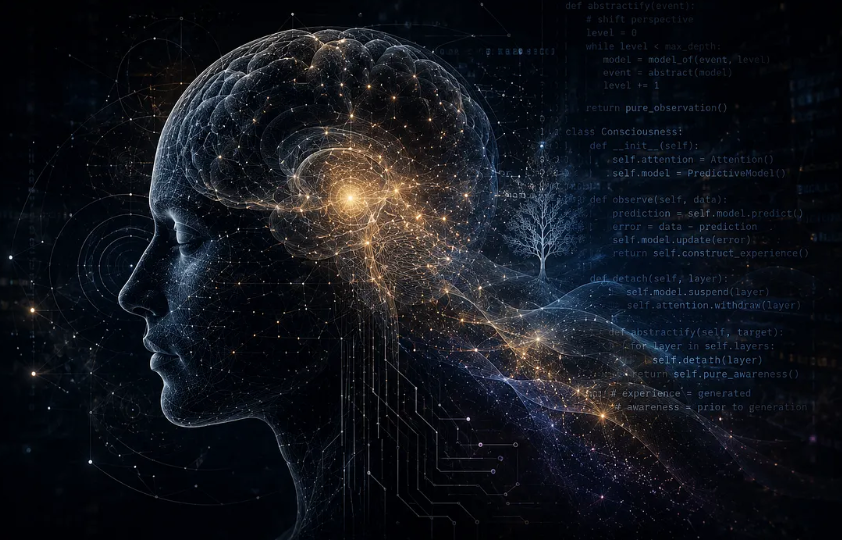
I call this move 'abstractify': deliberately shifting perception toward the underlying structural patterns rather than the emotional or narrative content. When you abstractify an emotion fully, something really strange happens. Your relationship to the emotion changes — often instantly.
Levels of Abstraction
Consciousness operates across different layers of abstraction. At the most concrete level, you have raw sensory data — the sound of rain, the tension in your shoulders. One level up, you have patterns: this sound is rain, that tension is anxiety. Higher still, you have narrative and meaning: this rain reminds me of childhood, this anxiety is about Monday's meeting.
Most people live almost entirely at the narrative level. Meditation, at its most fundamental, is practice at navigating all levels — and crucially, at choosing which level to occupy.
What Happens When You Abstractify
Advanced meditative states aren't mystical transcendence. They're what happens when you shift your viewpoint within consciousness to one with greatly reduced representational structure. These states feel spacious or empty because the brain is running at reduced predictive complexity — not because you've accessed some external realm.
The practical implication is significant: you don't need to 'solve' an emotion or understand its meaning to change your relationship to it. You can simply shift the level at which you're processing it. Structure, not story, becomes the tool.
This is the work. Not finding better meanings — but developing the perceptual range to move between levels of abstraction at will.