Exercise
Internal Consciousness: Imagination
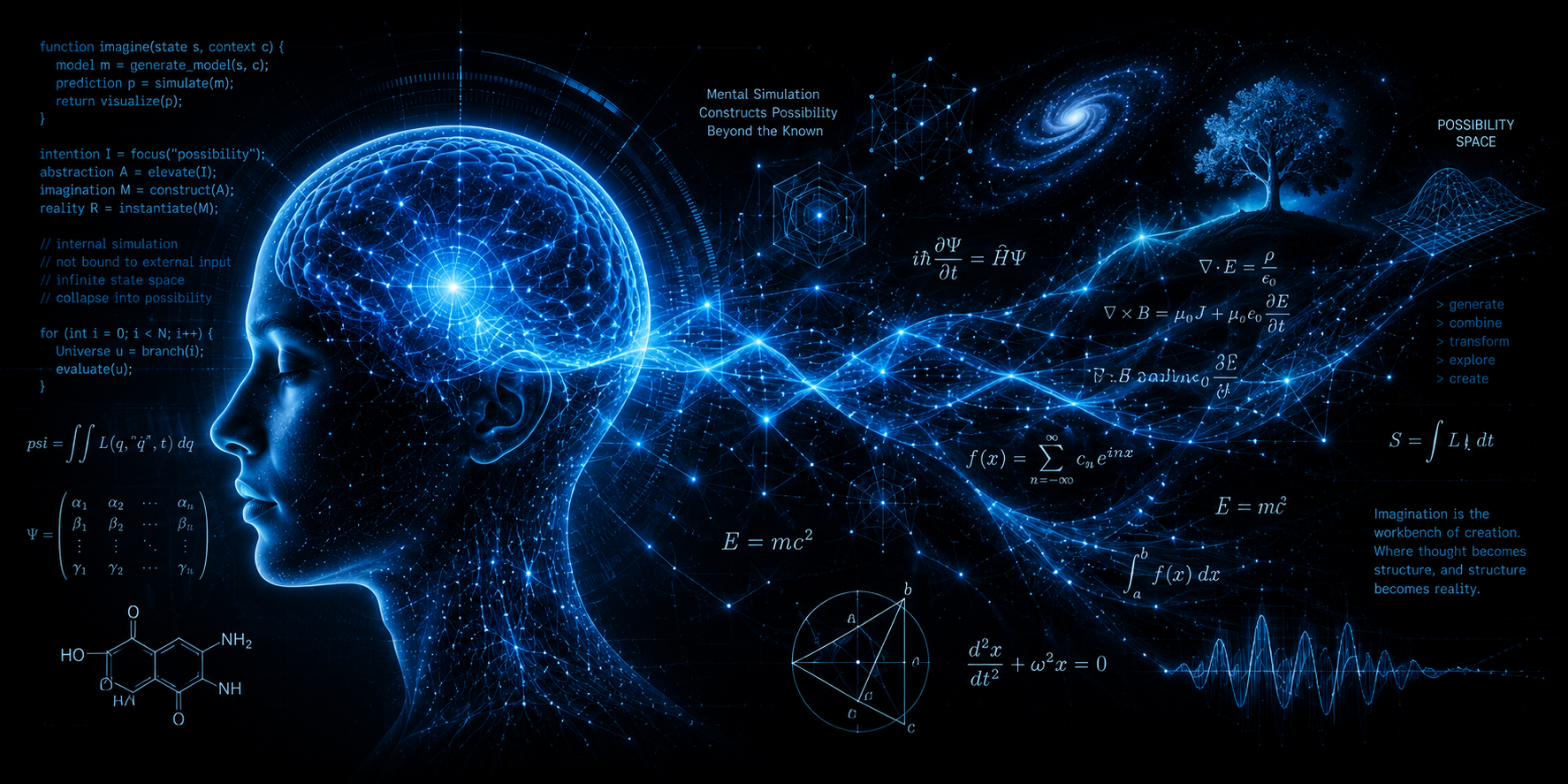
Imagination is the conscious ability to create mental images, scenarios, or ideas that are not directly available through our external senses.
Imagination can allow us to transcend the constraints of time, space, and our immediate environment. It can be stimulated by remembering past experiences, but it can also be part of a creative process to generate entirely new ideas or scenarios that may never have existed before. While imagination is often associated with creativity and innovation, it also plays a fundamental role in problem-solving, empathy, and decision-making.
Imagination is considered an internal consciousness sense, because like all our other internal consciousness senses, it is used to gather information using our attention, observation and perception.
Sadly, imagination is often neglected by many cultures, poorly taught in schools, and often mistakenly thought to be only useful if you work in creative fields such as art or design. Imagination is often not directly recognized or rewarded in many work environments. Imaginative solutions to problems may be not accepted by organizations, usually because they change or disrupt an existing way of doing things.
Imagination is the core of creativity. While creativity is a broader term that usually describes the process of both imagining new ideas and then putting them into practice in some way, imagination is the purely internal and brain-based part of that process.
Visualization is a specialized form of imagination, where we imagine in visual form. Often the distinction between thinking, visualization and imagination is difficult to clarify, especially for creative people who are highly skilled at combining them together. Architects and graphic designers typically can move smoothly around between all three, perhaps using the internal dialogue of thinking to analyze or describe a solution that they have imagined and visualized, or by asking questions where the result is visual or imagined rather than verbalized.
Like all our senses, our sense of imagination can sometimes become intrusive or overwhelming. Unchecked imagination can distort reality, leading us into fantasies that distract us or pull us away from practical action. Imagination can conjure fears or anxieties, making future scenarios seem worse than they may actually be. This is particularly true when we try to imagine ourselves doing something that we had a negative experience of in the past. When unchecked, this sort of runaway imagination can lead to stress, unrealistic expectations, action paralysis, or fear of possibilities that are unlikely to ever occur.
In consciousness training, we work to observe how imagination works and how to deliberately engage it in a useful way. Imagination is closely linked to all other internal consciousness senses. It allows us to explore alternate versions of future reality and if we use it well, gives us access to insights about our emotions, desires, worries, and our perceptions of the world around us.
IMAGINATION VS THINKING
Imagination is not the same as thinking, even though they often work together. Thinking tends to be more structured and focused and usually involve internal verbalization of our ideas, while imagination is more spontaneous and fluid. Imagination taps into a deeper, less structured part of our mind, where creativity and new possibilities spontaneously emerge into our mental space. The challenge is to observe our imagination at work without getting consumed by it, or having our imagination trigger emotions that we then can't manage deliberately. This level of deliberate control allows us to harness the power of imagination for specific purposes.
When we combine the sense of imagination with both our sense of memory and thinking, we can create stories and narratives that shape a new view of the world that addresses a remembered way of doing something that didn’t work for us in the past. Our identity is often built around these stories about what happened to us in the past — stories about who we are, what is possible, and how life works. These stories can empower us or limit us. If we wish to better ourselves, one of the most effective tools is to understand our existing stories, decide whether they serve us or, and if they no longer serve us, make a conscious decision to reshape these stories by using our imagination to create new ideas about how we want our future to be.
The stories we imagine about ourselves and the world around us directly impact how we behave in the present. If we consistently imagine negative outcomes because the stories that we are telling ourselves are about how things don’t work, we may trigger emotions we felt in the past, and then become paralyzed by those emotions,and make the same negative event occur again and again. If we imagine hopeful futures, we may feel inspired and motivated, and be challenged to take different actions to realize what we imagined. Learning to guide our imagination toward constructive and fulfilling visions can transform our relationship with reality and help us align our actions with the future we desire.
IMAGINATION AND EMOTIONS
One of the most powerful aspects of imagination is its ability to evoke emotions. Imagination can make us feel joy, excitement, or anticipation about something that hasn't even happened yet. But it can also trigger anxiety, sadness, or regret about events that may never occur. By recognizing when our imagination is at play, we can choose how much we want to invest in those emotions, which are often just a reflection of our imagined scenarios.
In meditation, deliberately working with imagination allows us to confront scenarios we may have been avoiding. Without this kind of awareness, many people are unwilling to imagine or remember challenging or distressing emotions. Just like with memory, our imagination can become a safe, playful and exploratory space where we explore unresolved fears, potential futures, and untapped desires. However, this requires practice, time and emotional regulation. As with any tool, imagination is only as powerful as the skill with which it is used.
When imagination, emotion and thinking work together, humans have the unique ability to innovate, create, and solve complex problems and pursue new experiences. While animals may operate on instinct, human imagination allows us to envision futures, design new technologies, explore artistic expression, or turn our lives around by making risky decisions with boldness and bravery. Through imagination, we generate ideas that move society forward, find new solutions to age-old problems, and make sense of abstract concepts that would otherwise be impossible to access using our other consciousness senses.
Exercise: Exploring Imagination
Find a quiet, comfortable place to sit where you won’t be disturbed for at least ten minutes. Close your eyes and bring to mind a simple mental image—something neutral or pleasant, like an imagined room that you would like to be in, a place in nature that you would find pleasant, or a familiar object. If nothing comes to mind, imagine holding a smooth stone in your hand. The key is to start with something simple and vivid enough to hold your attention.
Next, gently direct your attention to the most obvious aspects of that image — its shape, color, and texture. Observe it as if you were glancing at a painting for the first time, with curiosity but no pressure. Do this for about a minute. Notice if you are remembering something, or imagining something, and if are you aware of the difference. When we imagine objects or places, often we use our memory first to fill in some of the details, then use our imagination to change certain things.
Now, pour all your attention into imagining details of the image. Direct your focus deeper into its visual qualities—does it have texture? Does it cast a shadow? Is it moving or still? Then, shift your attention to any sounds, smells, or tactile sensations that might accompany it. If your mind wanders, gently bring it back to the original image and deliberately imagine it using a different consciousness sense. For instance, if you were imagining yourself in a place, imagine what the air would feel like on your skin in that place.
There is no right or wrong way to use your imagination. Some people see vivid pictures, others sense impressions without clear visuals. This practice is about learning how your imagination works — its clarity, its habits, and your unique way of constructing ideas in your mental space. Notice how stable what you imagine is. Is it very clear, or fuzzy and elusive? Does it shift on its own, or can you hold it steady?
Now, switch your attention to the meaning, associations or emotions this image carries. Does it remind you of anything? Does it evoke a feeling or memory? Observe any thoughts that arise without following them—just notice how your imagination can trigger these other consciousness senses.
Keep your attention relaxed, smooth and light. Imagination is a playful sense and it doesn’t respond well to over-asserting your willpower. Sometimes backing off a bit is all you need for your imagination to flow. If you find yourself straining or irritated, take a slow breath in, then release it fully, and return to the image with a lighter, less serious focus.
Once you’re comfortable, begin to play more actively with your image. Can you move through it, rotate around it, shift viewpoints within it? Experiment with altering one detail at a time, noticing how much control you have—and where the image seems to resist your efforts to change or explore in a certain way.
Now, explore its boundaries. If it’s a scene, how far does it extend? Can you zoom out to see more, or does it fade at the edges? If it’s an object, does it feel solid or intangible? This is a subtle exploration—take your time.
When you are ready, switch to another scene or place and see if it is easier or harder. As you shift, notice any resistance or ease to imagining different objects or places. Was something else immediately available, or did you have to search for the next image?
Continue imagining different places and things for at least 10 minutes. Then, check in with yourself. Do you feel more attuned to the nature of your own imagination? Do you feel more relaxed and energized? If the exercise feels frustrating, try a simple object and then work up. If your mind feels scattered, take a walk outside to ground yourself with a few minutes of the external consciousness sensing exercises from the previous section.
Self-Reflection: Imagination
Have you ever trained your sense of imagination consciously?
In what areas of your life do you find your imagination most active?
Are there some areas of your life where your imagination is overactive?
Do you consider your imagination to be a source of creativity, a source of stress, or both?
Have you ever found yourself stuck in a loop of negative or anxious imagination? If so, how did you get out of it?
When imagining the future, do you tend to envision positive or negative outcomes?
When engaging your imagination, do you feel playful?
Are there certain emotions or memories that trigger vivid imagined scenarios for you? How realistic are these scenarios? Are you able to distinguish whether they are really likely to occur or not? Where is the edge between ‘possible’ and ‘fantasy’.
Do you use your imagination more to plan for the future or create alternative versions of past events?
What role do you think imagination plays in shaping your view of the world?
Your PERSONAL Insights
Make notes in your journal about your relationship to your internal consciousness sense of imagination.